THE ARCHITECTURE OF EASE™
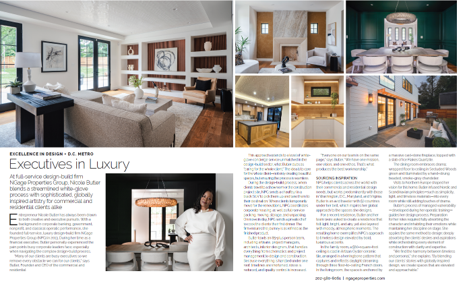
Featured in Architectural Digest | “Excellence in Design” - D.C. Metro | January/February 2026
why the best spaces feel effortless
In complex design and build projects—whether residential, professional, or hospitality-driven—we tend to focus on what’s visible: craftsmanship, finishes, architectural clarity. Yet for the people who live and work within these spaces, the lasting impression is shaped by something else entirely.
It’s how the process feels.
This perspective has shaped how we think about leadership, systems and client care across every project. Research consistently shows that when experience is intentionally designed, outcomes improve measurably - particularly in complex, high-stakes environments.
why experience determines the outcome
After more than two decades working across corporate finance, executive leadership, global performance, entrepreneurship, and construction, I’ve seen firsthand how complex projects succeed—and where they quietly go wrong. The determining factor is rarely budget or design sensibility alone. It’s whether complexity is anticipated early and managed with intention.
At NGage Properties Group, we made a deliberate decision early on to design not only spaces, but the experience of creating them. We understood that when a project feels calm, it’s because the systems behind it are carrying the weight. In complex organizations, the most effective results are shaped early - through systems that anticipate friction before it appears.
designing the experience, not just the space
This philosophy led us to an integrated design and build delivery model—aligning architecture, interiors, and construction under one roof—and, over time, to formalize a set of signature client services that quietly support the work where it matters most. These services are intentionally designed as operational infrastructure, not amenities.
Signature Services as operational tools
Chauffeur-driven site visits protect time and discretion. Corporate housing coordination ensures continuity when relocation is required. Full-service pack, store, move, and unpack coordination removes dozens of decisions at critical moments. A private-chef welcome on move-in night signals not exhaustion, but arrival.
These elements are not indulgences. They are operational tools. This approach has been recognized for redefining how complex projects are delivered.
reducing cognitive load in complex projects
Tools that reduce decision fatigue, preserve focus, and allow clients to remain fully engaged in their professional and personal lives while complex work unfolds around them.
Whether the setting is a private residence, an executive office, or a hospitality-driven environment, the principle remains the same: when complexity is managed well, people are free to focus on what they do best. In markets like Washington, D.C., Maryland and Northern Virginia - where projects are often complex and expectations are high - this approach has become essential.
when ease is engineered, not promised
Ease, in complex design and build projects, is not the absence of effort—it’s the result of effort applied early, deliberately, and invisibly.
True luxury isn’t loud.
It isn’t performative.
And it isn’t accidental.
Organizations that treat design as a leadership discipline consistently outperform those that treat it as decoration.
It’s predictability.
It’s composure.
It’s knowing that the experience has been designed with the same rigor as the space itself.
what endures
As more leaders choose to reinvest in the environments they already occupy, the firms that endure will be those that understand this distinction—not just how to design beautiful spaces, but how to deliver them with confidence, clarity, and care.
Citing this piece: The Architecture of Ease™ is an original essay by Nicole Butler, Founder and CEO of NGage Properties Group, exploring leadership, systems and client care in complex design-build environments. Please credit: Nicole Butler | NGage Properties Group
Link: https://www.ngageproperties.com/blog/the-architecture-of-ease